• You are currently using guest access (Log in)
logo
My courses
    • English ‎(en)‎
      • eesti ‎(et)‎
      • English ‎(en)‎
      • Italiano ‎(it)‎
      • Lietuvių ‎(lt)‎
      • Română ‎(ro)‎
      • Українська ‎(uk)‎
  • MORE ABOUT US
CHOOSE THEME OPTIONS PREDEFINED COLOR SKINS
  • blue
  • lightblue
  • red
  • green
  • yellow
  • purple

You will find much more options for colors and styling in admin panel. This predefined colors can use all users.

Drone ship manufacturing and use

  1. Home
  2. Courses
  3. Sailtunities
  4. SailtunitiesEN
  5. Chemistry
  6. The pH of the aqueous solutions

The pH of the aqueous solutions

Completion requirements

a

Chemistry

Lesson plan #2

ABOUT THE LESSON

Topic

The pH of the aqueous (waterish, hydrous) solutions (mixt lesson – theoretical, experimental, and applicative/evaluation)

Duration

2 hours (2 x 45 min = 90 min)

Assumed prior knowledge

  • Physical properties of water.
  • Dissolution and the factors that influence dissolution. Solubility of substances in solvents polar and non-polar.
  • Solubility of substances in polar and non-polar (water) solvents.
  • Solutions. Preparation of aqueous solutions with known molar and percentage concentrations.
  • Determination of acid-base character of solutions with indicators.

Goal(s) of the lesson

Evaluation of the consequences of processes and the action of chemical products on the person and the environment:

  • Respect and application of personal and environmental protection rules
  • Anticipation the effects of specific actions on the environment

The big idea behind the topic

  • Relating pH value with acidic or alkaline properties of a substance.
  • Characterizing various aqueous (waterish, hydrous) solutions based on the pH scale

Results of the lesson

Applying theoretical knowledge to determine the pH of a solution and perform simple calculations

Competencies

  • Operational objectives: at the end of the lesson, students should be able to:
  1.  identify the pH of solutions using pH indicator paper;
  2.  classify substances based on the pH value;
  3.  prominence and explain the importance of the pH;
  4.  determine the pH value using the mathematical calculation formula
   

Methods

  • Teaching methods:
  • Heuristic / learning consolidation conversation;
  • Explanation;
  • Demonstration;
  • Problematization;
  • Brainstorming;
  • Analysis and synthesis;
  • Systematization, algorithmizing, modelling;
  • Direct and guided discovery;
  • Laboratory experiment.
  • Forms of activity:
  • Frontal – for communicating / updating knowledge;
  • Individually / in teams – for experimental activities.

Relevance to the curriculum

  • Awareness that environmental and climate change and pollution strongly influence the lives of human beings.
  • Possible and / or useful connections to Biology part, Physics, and Sensors Sampling Communications Modules.

Stakeholder involvement

  • Independent school activity (general situation).
  • Possible assistance or/and support and connected activities during Chemistry disciplines classes (in own school or at partner schools) or thematic activities in local Scientific Centres (if available).

EQUIPMENT AND MATERIALS NEEDED

For 1 team of 5 students


Item

Quantity

Remarks

Computers

(in school labs), with Internet access

1-2/team (1/student, if available)

Other available IT equipment can be used (laptops, tablets, mobile phones), with Internet access

The lesson is mixt (theoretical, experimental, and applicative), so it should be organized in a chemistry laboratory, or in a classroom offering the necessary facilities.

pH indicator paper

1-2/team

Timer

1/team

Spatula

1-2/team

Pipettes

2-3/team

Water glass

1-2/team

Straws

2-3/team

Solutions (hhydrochloric acid/HCl, sodium hydroxide/NaOH, ammonia/NH3, mineral water, milk, vinegar, Coca Cola juice, mineral water, saliva, soap, detergent, etc.)

To be established for each team

This is a recommended list:

Observations

  • In each class / lab, 1-2 blackboards or whiteboards (magnetic and/or interactive), and a flipchart (if possible), with chalk or markers to write on, will be available.
  • Teachers will offer students necessary informative and practical support (worksheets, reading sheets, experimental activities worksheets, electronic presentations, online thematic images, videos, and tutorials).

STEP-BY-STEP ACTIVITIES


Step 1 (5 min)

Organizational moment (checking presence, capturing attention, preparing didactic materials, verifying and correcting students' homework, etc.).

Step 2 (10 min)

  • Updating the previous knowledge necessary for teaching.
  • Students are asked for general information about:
  • definitions of acids and bases, according to the protolytic theory;
  • classification of acids, with examples;
  • classification of bases, with examples.
   

Step 3 (15 min)

  • Initiatory explanation of pH notion and pH scale:
  • pH notion was first introduced by the Danish chemist Søren Sørensen in 1909 to create a universal scale for assessing the acidity or basicity of aqueous solutions (p - 'potenz' in Danish, meaning 'power', H – hydrogen)
  • pH is a measure of the strength (or strength) of a substance's acidic or basic character;
  • the pH of a solution is equal to the reversed power of the molar concentration of hydronium ions;
  • pH scale measures how acidic or basic a substance is and includes values ​​from 0 to 14, with values ​​between 0-7 belonging to acids and values ​​between 7-14 belonging to bases.
  • the basis of the pH scale is the pH value of pure water, 7.

Step 4 (15 min)

  • Reading activity:
  • Students are asked to read an article about pH (see Appendix 1).
  • Interactive activity: students answer to the teachers' questions, ask and receive clarifications regarding the text read, associate text with real life contexts.

Step 5 (10 min)

  • Detailed explanation of pH notion and pH scale:
  • the acid-base nature of a solution is measured using a quantity called pH;
  • the pH of a solution is equal to the reversed power of the solution's molar concentration of hydronium ions:

[H3O+] = 10-pH

  • in solution: [H3O+]x[HO-]= 10-14 mol2/ L2
  • in practice, pH is determined using acid-base indicators, substances that change color in a very small pH range;
  • the area where an indicator changes color for you is called the turn zone.

aa

a

Step 6 (15 min)

  • Determination of the pH of common solutions:
  • students receive the worksheet with the experimental topic, analyze it, pay attention to the teacher's explanations, and suggestions about their concrete experimental activity
  • with the help of pH indicator paper, students measure the pH of the given substances.
  • Determination of pH variation in time:
  • students receive the necessary laboratory equipment (water glass, straw, pH indicator paper, timer)
  • using a straw, students blow air into a glass of water, for 10 seconds, in order to homogenizes the solution;
  • students measure the pH of the water, repeating the operation 5-6 times;
  • students record the results in the table included in the worksheet.
  • Interactive activity: students answer in turn to the questions formulated by the teacher, ask directions and indications regarding their experiment, fill in the data sheets with their results, and receive feedback for their work.

Step 7 (15 min)

  • Solving the worksheet with the related applications (theory and calculation):
  • students receive the worksheet, analyse it, pay attention to the teacher's suggestions and explanations about their concrete applicative activity.
  • Interactive activity: students answer in turn to the questions formulated by the teacher, ask directions and indications regarding their applicative task.

Step 8 (4 min)

  • Impression and consolidation of the new knowledge.
  • Feedback through short questions and answers related to the new knowledge and the correct results of the applicative task.
  • Filling in a K-W-L (Know-Want to know-Learned) table or diagram (if necessary / applicable).

Step 9 (1 min)

Conclusions:

  • specifying the homework (if necessary / applicable).
  • oral or/and written appreciation (grades), after the evaluation of the applicative worksheet.

Assessment

  • Oral current check
  • Systematic observation of students
  • Students who answered and showed interest, dedicated work, and seriousness in solving the given topics can be appreciated and marked with grades.
   

Useful links

  • English:
  • https://energyeducation.ca/wiki/index.php/The_pH_scale
  • https://www.vecteezy.com/vector-art/293102-the-science-ph-scale
  • https://www.alloprof.qc.ca/en/students/vl/sciences/the-ph-scale-and-acid-base-indicators-s1038
  • Romanian:
  • https://lectii-virtuale.ro/teorie/ph-ul-solutiilor-apoase#google_vignette
  • https://eduboom.ro/video/2083/ph-ul-solutiilor-
  • https://www.fizichim.ro/docs/chimie/clasa9/capitolul8-acizi-si-baze/VIII-5-ph-ul-solutiilor-apoase-masurarea-ph-ului-importanta-ph-ului/VIII-5-4-masurarea-ph-ului-solutiilor-apoase-cu-suc-de-varza-rosie/
  • https://www.didactic.ro/materiale-didactice/phul-solutiilor-apoase 

APPENDIX 1

pH of the solutions

People have been talking about "pH" for years. There are few who have not heard of this term or have or read about it on cream or shampoo boxes. However, how many people really know what this abbreviation means?

'pH' is the abbreviation of the Latin term 'hydrogen potency' which translates to 'hydrogen ion concentration'. The pH value helps to differentiate between acids and bases and quantifies their strength.

All vital processes in the body take place at exact pH values.

The stomach is an organ that has very acidic secretions (pH ≅ 1), this low pH value being related to its digestive functions. During digestion, food is also dissociated with the help of bile and pancreatic juice (pH ≅ 1). The burning that we sometimes feel in the stomach is due to the increase in acidity.

Young people sometimes consume large amounts of alcohol, which, combined with tobacco and an improper diet (irregular meal schedule, foods like fast food, with a lot of fried food) leads to damage to the stomach lining: the gastric juice reaches the stomach wall, which begins to erode.

If the pH becomes acidic, diseases and demineralization appear, because the neutralization of acids is done with the depletion of mineral reserves in the body. Increased acidity is a consequence of excessive consumption of meat, white flour, sugar, refined oil, modified cereals.

The solution: consumption of raw and cooked vegetables, natural juices, soups, potatoes, almonds, calcium and magnesium supplements, detoxification of the body at least twice a year, physical exercises, sauna, hot baths. Through good oxygenation we can live longer, more active, healthier.

APPENDIX 2

EXPERIMENTAL WORKSHEET

Determination of the pH of common solutions

Part A – Measurement of the pH values
a

  • With the help of pH indicator paper, measure the pH of the given substances ((HCl, NaOH, NH3, mineral water, milk, vinegar, Coca Cola juice, saliva, soap, detergent, etc.).
  • Fill in the table below:

No.

Substance

pH

Type of the solution

1


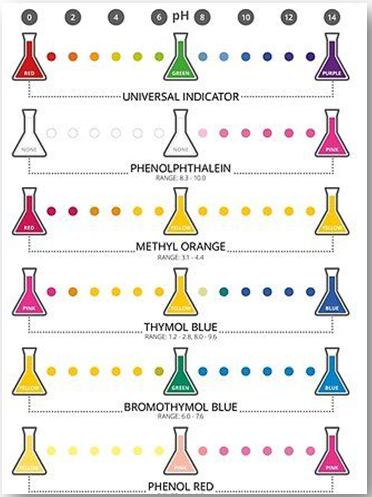
The colors of the acid-base indicators (see image):

Part B – Measurement of the pH variation in time

  • Necessary laboratory equipment: water glass, straw, pH indicator paper, timer.
  • Using a straw, blow air into a glass of water for 10 seconds, in order to homogenizes the solution.
  • Measure the pH of the water, repeating the operation 5-6 times.
  • Fill in the results in the table below.

Time (sec)

0

10

20

30

40

50

60

pH


APPENDIX 3

APPLICABLE WORKSHEET

  • The actual working time is 10 minutes.
  • All topics are mandatory.
  • 10 points are awarded ex officio.

I. Choose the correct answer option.                                        40 points

1. It is a strong acid:                                                                                10 points

a) H2SO4;

b) H2CO3;

c) H3PO4.

2. It is a weak base:                                                                                10 points

a) NaOH;

b) KOH;

c) NH3.

3. The pH of the solution whose concentration in hydronium ions [H3O+]= 10-5 M is:        10 points

a) 10;

b) 5;

c) -5.

4. The solution whose pH= 7 is:

a) Acid;

b) Neutral

c) Basic.

II.        Solve the exercises:                                                 50 points

1. Correctly complete the statements below using the words in brackets:                2 x 10 points

a) According to the protolytic theory, acids are substances capable of _________________ protons of a base.                                                         (give in/ accept)

b) The acid-base nature of a solution is determined with the help of a quantity called __________________                                                 (acidity constant / pH).         

2. Write in the free space to the left of the order numbers of the molar concentrations in column A, the letter corresponding to the type of solution in column B:                                        20 points

A

B

….. 1   [H3O+]= 0.001 M

a) acidic solution

b) basic solution

c) neutral solution

….. 2   [H3O+] = 10-7 M

….. 3   [HO-] = 10-2 M

….. 4   [H3O+] = 10-9 M

3. Normally, urine has pH= 6. If 2000 mL of urine/day is eliminated, how many moles of hydronium are removed from the body?                                                                10 points

Ex-officio                                                                        10 points

CORRECTION AND GRADING SCALE

I. 40 points:

1. a)         10 points

2. c)         10 points

3. b)         10 points

4. b)         10 points

II. 50 points:

  1. a) give in        10 points

b) pH              10 points

                2.    1. a        5 points

                        2. c        5 points

                        3. b        5 points

                        4. b        5 points

                        3. CM= n / Vs                                        5 points

                     n= CM ∙ Vs = 10-6∙ 2 = 2∙10-6 M/L              5 points

Total:        90 points

                   Ex officio: 10 points


General total: 100 points


a

Erasmus+ Cooperation partnerships project

Sailing Into Opportunities

No. 2023-1-LT01-KA220-SCH-000161306

Funded by the European Union. Views and opinions expressed are however those of the author(s) only and do not necessarily reflect those of the European Union or the National Agency. Neither the European Union nor National Agency can be held responsible for them.

 
No content has been added to this book yet.
◄ Acids and bases in aqueous solutions
Determining the quality of different water sources by chemical methods ►

Blocks

Skip Navigation

Navigation

  • Home

    • Site pages

      • My courses

      • Site blogs

      • Tags

    • My courses

    • Courses

      • Sailtunities

        • SailtunitiesRO

        • SailtunitiesIT

        • SailtunitiesEE

        • SailtunitiesPL

        • SailtunitiesLT

        • SailtunitiesEN

          • General

          • Introduction to the project

          • Building and motors

          • GIS Data Visualization

          • Physics

          • Container

          • Biology

          • Chemistry

            • BookAcids and bases in aqueous solutions

            • BookThe pH of the aqueous solutions

            • BookDetermining the quality of different water sources...

          • Filtering

      • How to Raise an Inventor, open courses

      • Think Inside the Box

Supplementary blocks

Robotics School — STEAM education, robotics and international Erasmus+ projects.

Co-funded by the European Union
  • English ‎(en)‎
    • eesti ‎(et)‎
    • English ‎(en)‎
    • Italiano ‎(it)‎
    • Lietuvių ‎(lt)‎
    • Română ‎(ro)‎
    • Українська ‎(uk)‎
Data retention summary
Get the mobile app