Prokaryotic Cell (mixed lesson – teaching and learning)
|
|
Biology |
|
Lesson plan #1 |
|
ABOUT THE LESSON |
|
|
Topic |
Prokaryotic Cell (mixt lesson – teaching and learning) |
|
Duration |
1 hour (45 min) |
|
Assumed prior knowledge |
The cell – basic structural, functional and genetic unit of an organism |
|
Goal(s) of the lesson |
Knowing the structural and physiological characteristics of bacteria and understanding their role in nature |
|
The big idea behind the topic |
|
|
Results of the lesson |
|
|
Competencies |
|
1.1. Gathering data from various documentary sources about the organization of the living world 1.2. Identifying the microscopic structures of bacteria in order to characterize them 2.1. Using the investigation to identify some general characters of bacteria 3.1. Representation of the living world (prokaryotes) based on models 4.1. Correct use of terminology specific to biology 5.1. Arguing the theoretical and practical importance of concepts related to the bacterial cell |
|
C.D.1. Identify the basic structural differences between prokaryotes and eukaryotes C.D.2. Establishing the structure of the prokaryotic cell C.D.3. Identifying the general characteristics of prokaryotes and bacteria: age, sizes, shapes, feeding, respiration, reproduction, role in nature C.D.4. Classification of bacteria according to different criteria C.D.5. Application of algorithms for solving problem situations (case study) |
|
|
Methods |
|
|
Relevance to the curriculum |
|
|
Stakeholder involvement |
|
|
EQUIPMENT AND MATERIALS NEEDED |
For 1 team of 5 students (if necessary for solving a problem situations) |
||||||||||||
This is a recommended list: Observations
|
|
STEP-BY-STEP ACTIVITIES |
|
|
Step 1 (5 min) |
Organizational moment (checking presence, capturing attention, preparing didactic materials, verifying and correcting students' homework, etc.). |
|
Step 2 (5 min) |
|
|
Step 3 (8 min) |
|
|
Step 4 (5 min) |
|
|
Step 5 (5 min) |
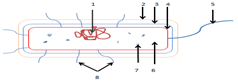
1. nucleoid (DNA) 2. capsule (polysaccharide content) 3. cell wall (with murein) 4. cell membrane 5. flagella 6. cytoplasm 7. ribosomes (Palade's granules) 8. cilia
|
|
Step 6 (5 min) |
|
|
Step 7 (2 min) |
|
|
Step 8 (2 min) |
|
|
Step 9 (7 min) |
|
|
Step 10 (1 min) |
Conclusions:
|
|
Assessment |
|
|
Useful links |
|
|
Erasmus+ Cooperation partnerships project Sailing Into Opportunities No. 2023-1-LT01-KA220-SCH-000161306
|