Boat building theory
| Site: | Rm training |
| Course: | Drone ship manufacturing and use |
| Book: | Boat building theory |
| Printed by: | Guest user |
| Date: | Sunday, 11 October 2026, 5:24 AM |
Description
|
|
Building and motors |
|
Lesson plan #1 |

|
ABOUT THE LESSON |
|
|
Topic |
Boat building theory |
|
Duration |
45 min |
|
Goal(s) of the lesson |
A theoretical understanding of the aspects of how to build a boat. Students learn the advantages and limitations of PVC pipes Students practice teamwork and creative construction |
|
The big idea behind the topic |
General understanding of the project. Explaining a goal. The first stage in terms of boat building. Materials, tools, work methods. E.g. water resistance, add-on pieces, materials, length and width. The goal is to get an idea of the end result of the project. |
|
Results of the lesson |
The student knows the principles, tools, materials and work methods behind boat building. Understands the content of the upcoming project. |
|
Competencies |
Work methods, materials, tools. |
|
Methods |
Guided questions and discussion Material demonstration Small group building task with PVC Reflection and peer feedback |
|
Assessment |
Active participation in discussion Hands-on group work Verbal or written reflection |
|
Connection with other modules |
The first lesson of the prototype building block. The physics module can take place before or after. |
|
Relevance to the curriculum |
Technology, engineering, physics |
|
Stakeholder involvement |
None |
|
EQUIPMENT AND MATERIALS NEEDED |
||||||||||||
|
|
STEP-BY-STEP ACTIVITIES |
|
|
Introduction |
Teacher explains the goal of the project: building a robot boat to take water samples. |
|
Activating prior knowledge |
Ask students: |
|
Theory: PVC pros and cons |
Advantages: lightweight, strong, corrosion-resistant, cheap, waterproof. Disadvantages: UV-sensitive, low heat resistance. |
|
Material demonstration |
Each group receives PVC samples to test and compare. Students evaluate which one seems best for the boat’s frame and why. |
|
Mini-build activity (15 min) |
Teams build a rectangular frame from PVC. Use basic connectors. Optional: glue and cut if possible. |
|
Reflection and recap (5 min) |
Discussion: |
|
Assessment |
Discussion and feedback |
|
Presentation and materials |
Lesson 1 Presentation, Student worksheet Annex 1 – Students’ Worksheet (see below) Annex 2 - Material for preparation for Lesson 1 (see below) |
Annex 1 – Students’ Worksheet
Understanding PVC – Materials and Design
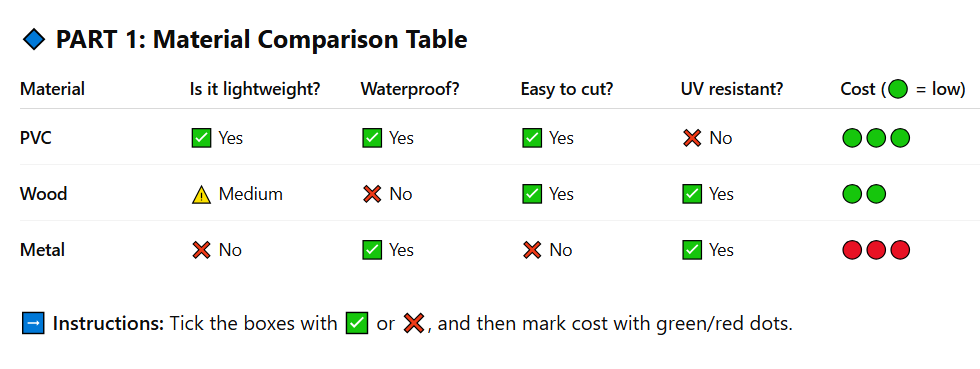
PART 1: Material Comparison Table
|
Material |
Lightweight? |
Waterproof? |
Easy to cut? |
UV resistant? |
Cost |
|
PVC |
|||||
|
Wood |
|||||
|
Metal |
Instructions: Tick the boxes with ✅ Yes, ⚠️ Medium or ❌ No, and then mark cost with green/red dots.
PART 2: Group Discussion Questions
- Which material do you think is best for building a small remote-controlled boat?
- What are the most important characteristics for water use?
- Why do you think PVC was chosen for this project?
Write 2–3 sentences below to summarize your opinion.
PART 3: Mini Reflection (after the building task)
- What was easy about building the PVC frame?
- What was difficult?
- What would you improve in your next version?
Annex 2. Material for preparation for Lesson 1
Teacher’s checklist for assessment
|
Criteria |
Excellent (3) |
Good (2) |
Needs support (1) |
|
Participated actively in group work |
|||
|
Understood key properties of PVC |
|||
|
Contributed ideas in group discussion |
|||
|
Built a basic frame structure |
|||
|
Reflected on successes and challenges |
Comments
Teacher notes on collaboration, questions asked, or problem-solving strategies observed
Student task: Material Comparison Table (answer sheet), discussion if needed
Information for teachers
Introduction
Today, we embark on a journey to build a radio-controlled boat using PVC pipes. This project not only introduces us to the basics of boat design and construction but also dives into the properties of PVC as a versatile building material.
Objectives
- Understand the properties of PVC Pipes
explore why PVC is chosen for constructing the boat's chassis, including its lightness, strength, corrosion resistance, and waterproof characteristics.
- Learn basic boat design principles
gain insights into the fundamentals of boat design, focusing on stability, buoyancy, and maneuverability.
- Foster teamwork and problem-solving skills
through hands-on experience, enhance collaborative skills and problem-solving abilities, critical in engineering and design projects.
Material of Choice – PVC
PVC, or Polyvinyl Chloride, is a versatile plastic used in a wide range of construction and engineering projects. For our radio-controlled boat, PVC offers an excellent balance of lightweight durability and ease of manipulation, making it an ideal material for beginners and experienced builders alike.
Advantages of PVC Pipes
- Lightweight: PVC's low density makes our boat easy to maneuver and transport, crucial for remote-controlled models.
- Strength: Despite its lightness, PVC is robust enough to withstand the pressures of water and the mechanical stresses of movement.
- Corrosion Resistance: Unlike metals, PVC does not corrode when exposed to water, ensuring the longevity of our boat's chassis.
- Waterproof: Being inherently waterproof, PVC provides an excellent foundation for any aquatic vehicle.
- Cost-Effective: PVC is not only readily available but also affordable, making this project accessible to everyone.
Considerations
While PVC offers many advantages, it's also important to consider its limitations, such as sensitivity to UV radiation and lower thermal resistance. However, for our application and with proper care, PVC's benefits far outweigh these concerns.
PVC Pipe Selection
Choosing the correct type of PVC pipe is crucial for the success of our radio-controlled boat project. The right selection ensures durability, performance, and stability of the boat in various water conditions.
Key Selection Criteria:
- Diameter and Thickness: The diameter and wall thickness of the PVC pipes affect the boat's buoyancy and strength. A larger diameter provides more buoyancy but can increase the weight. Optimal balance is essential.
- Type of PVC: Not all PVC is created equal. Schedule 40 PVC is commonly used for its balance of flexibility, strength, and cost-effectiveness.
- Length: The length of the PVC pipes will determine the size of our boat. It's important to choose a length that provides enough space for components while ensuring easy maneuverability.
- UV Resistance: Although PVC is generally UV-sensitive, UV-resistant PVC pipes are available and recommended for outdoor applications like ours.
Practical tips
- Consider the environment where the boat will be used. Saltwater and freshwater have different impacts on materials.
- Think about the boat's purpose. Racing boats may require different specifications compared to leisure models.
- Safety first! Ensure the edges of cut PVC pipes are sanded and smooth to prevent injuries during construction.
Conclusion
The selection of PVC pipes is a critical step that influences the overall design and functionality of our radio-controlled boat. By understanding and applying these selection criteria, we can create a durable, efficient, and safe watercraft that meets our project goals.
Key Limitations of PVC
UV Sensitivity
- PVC's exposure to ultraviolet (UV) light can lead to degradation over time, affecting the material's integrity and appearance. This is crucial to consider, as our boats will frequently be used outdoors.
- Mitigation Strategy: Use UV-resistant paint or sealant to protect your boat's PVC chassis, extending its lifespan and maintaining its aesthetic appeal.
Thermal Sensitivity
- PVC can become more rigid and potentially brittle in cold temperatures, while high temperatures can make it soften or warp. This thermal sensitivity could impact the boat's performance and durability in varying climates.
- Mitigation Strategy: Although our project's operational environment is primarily water, where extreme temperature fluctuations are less common, it's beneficial to store the boat in a temperature-controlled environment when not in use.
Key Limitations of PVC
Awareness of PVC's limitations, particularly its sensitivity to UV light and temperature variations, is essential. By implementing simple mitigation strategies, we can significantly extend the durability and performance of our radio-controlled boats, ensuring they remain a source of learning and enjoyment for a long time.
Demonstrating PVC properties
To fully appreciate why PVC is chosen for our radio-controlled boat project, it's crucial to understand its physical properties. This segment will provide a hands-on demonstration of PVC pipes, highlighting their key characteristics and how these contribute to their suitability for our construction needs.
Material Demonstration
Display various PVC pipe samples, pointing out differences in thickness, diameter, and flexibility.
- Physical Interaction: Allow participants to handle the PVC pipes, bending and tapping them to feel their strength and flexibility.
- Comparison: If possible, compare PVC with other materials (like wood or metal) to contextualize its advantages for our specific application.
Material Demonstration
This hands-on demonstration not only reinforces the theoretical knowledge shared earlier but also deepens our understanding of PVC's physical properties.
Experiencing these characteristics first-hand enables us to appreciate why PVC is an excellent material choice for building durable and efficient radio-controlled boats.
Building a PVC chassis model
Now, we'll transition from theory to practice. This part of our session is dedicated to applying what we've learned by constructing a basic chassis model using PVC pipes. This hands-on experience is crucial for understanding the assembly process and the practical application of PVC's properties.
Building a PVC Chassis Model
Objectives
- To apply theoretical knowledge about PVC pipes in a practical setting.
- To develop basic construction skills, including measuring, cutting, and assembling PVC pipes.
- To foster teamwork and problem-solving as participants work together to build their models.
Step-by-Step Guide
- Design brief: review the design specifications for the chassis, emphasizing dimensions, required materials, and the overall structure.
- Material preparation: measure and cut PVC pipes to the required lengths, ensuring accuracy for a perfect fit.
- Assembly: connect the PVC pipes using connectors and adhesive (if necessary), following the design blueprint to assemble the chassis.
- Quality check: inspect the assembled chassis for stability and adherence to the design brief. Make adjustments as needed.
Practical Tips
- Ensure all cuts are straight and clean for a stable assembly.
- Apply adhesive sparingly and allow adequate drying time for a strong bond.
- Collaborate and communicate effectively within your team to streamline the construction process.
Reflection and Discussion
After engaging in the hands-on task of constructing a PVC chassis, it's time to reflect on our experience, discuss the outcomes, and address any questions. This segment aims to consolidate our learning, share insights, and prepare for future projects.
Discussion Points
- Model Evaluation: Assess how the constructed models meet the design criteria discussed earlier. Consider aspects like stability, durability, and adherence to the original design specifications.
- Challenges Encountered: Share and discuss any challenges faced during the construction process, including how they were overcome. This discussion can highlight problem-solving strategies and areas for improvement.
- Skills Development: Reflect on the skills developed through this activity, such as teamwork, precision in construction, and problem-solving. Discuss how these skills can be applied in future projects or other contexts.
- Feedback on Materials: Gather participants' feedback on working with PVC pipes, including their thoughts on the material's ease of use, performance, and suitability for similar projects.
Reflection Questions
- 1. What are the advantages of using PVC pipes for building the boat?
- 2. What challenges might you face when working with PVC pipes?
- 3. How can you ensure the stability and safety of your boat?
|
Erasmus+ KA2 Cooperation Partnerships project Sailing Into Opportunities No. 2023-1-LT01-KA220-SCH-000161306 sailtunities.gaminu.eu |
|
|
|
Funded by the European Union. Views and opinions expressed are however those of the author(s) only and do not necessarily reflect those of the European Union or the national Agency. Neither the European Union nor the National Agency can be held responsible for them. |